
 Show Posts
This section allows you to view all posts made by this member. Note that you can only see posts made in areas you currently have access to.
Pages: [1]
1
Bazi / Re: Ten heavenly stems Chinese Characters
« on: November 05, 2024, 01:00:09 AM »
Hi Ren, as you suggested, I have made some changes and notes to the translation so that it is more understandable.
This excerpt is from the article The origin, arrangement and belief of the zodiac signs, that collects some hypotexts on the origin and arrangement of animals in terrestrial branches, this passage concerns the relationship between earthly branches and animals from the perspective of the twelve ancient hours of day and night. Zhu Xi, a famous Neo-Confucian scholar of the Song Dynasty, supported this view.
Note: many of the explanations have nothing to do with the meanings of the original pictograms.
“... The zodiac originated from the atmosphere of the ancient cult of animals and the cult of totems.
Ancient Chinese scholars explained the relationship between earthly branches and animals from the perspective of the ancient twelve hours of day and night:
The sky is black and the earth is in chaos. The mouse comes out in the middle of the night and bites into the chaos between heaven and earth. "The mouse bites the sky and opens it", so 子 Zi meaning child (beginning) takes the name of mouse in the earth's branches.
After the sky has opened, the next step is to create the earth and "the earth was created out of ugliness. The oxen that plow the fields are supposed to be the things that created ( given foundation 创) the earth, so CHOU 丑 which took on the meaning of "ugly" (probably because the inscriptions on the oracle bones resemble claws) takes the name of Ox in the terrestrial branches.
The time of Yin is the moment when a person is born. Life leads to death. Nothing can kill people more than a ferocious tiger. Yin also has the meaning of reverence, so 寅 Yin takes the name of tiger in the terrestrial branches.
The Mao hour is the symbol of dawn. The sun should be Li Gua, (east)
Li Gua (east) is like fire and the Yin Yao (Yao maybe brilliant, hence the bright yin) in it is the essence of the sun or moon. (the rabbit was considered a good omen) In this way, 卯 Mao takes on the name of rabbit.
Chen, the hexagram of March, is the season when dragons make rain. Chen is naturally a dragon.
Already the hexagram of April means that at this time the spring grass is lush, which is a good time for snakes, like fish in water. Also, it is morning, and at this time the snake is returning to its cave. So 巳 Si is snake.
At noon, in the afternoon, Yang Qi reaches its extreme and Yin Qi emerges. Horses are animals that gallop and run with their hooves in the air, but occasionally touch the ground. Flying in the air is yang, walking on the ground is yin, and the horse jumps between yin and yang; thus, it becomes the zodiac sign of noon, WU午 means noon and takes the name of Horse in the terrestrial branches.
For sheep, the best time to eat grass is in the afternoon, because it is easy to gain weight. This is the wrong time, so it's not a sheep.
Note: this last sentence makes little sense, I don't know if the problem is in the translation from Chinese that google proposes, however the meaning of Wei (whose character contains the wooden radical and in full: the character "Wei" in the inscriptions on the bones of the oracle resembles the shape of a tree with overlapping branches and leaves. It is said to be an ancient tree with a crown and branches curved upwards, and the leaves have a salty taste.) It includes "not, not yet, unfinished" and can also mean to taste, then eat. Be that as it may, Wei takes the name of sheep in our twelve earth branches.
Shenshi 15:00 to 17:00 is the time when the sun approaches the Western Mountain and the monkeys sing, and the monkeys like to stretch their arms and jump at this time; therefore, the monkey is paired with Shen 申.
You is when the moon appears. The moon belongs to water and corresponds to Kan Gua. The Kan hexagram has yin lines above and below, and the yang line in the center represents the essence of the sun and the golden raven. (The moon in mid-autumn sways and points towards the unified sky.) So, the Unit belongs to the rooster. You 酉 takes the name Rooster
When night falls, it's Xu's time. (Xu Shi, twilight, At this time the sun has set and it will be dark. The sky and the earth are dimand everything is foggy, so it is called twilight, it goes from 7 to 9 in the evening and belongs to the Xu hour.) Dogs are the pets that keep watch at night, so Xu 戌is the Dog in the twelve branches of the earth.
Then comes Haishi, the hour of Hai, and heaven and earth are plunged into a state of chaos, just like a fruit wrapped in a core. Everything in the world is covered at night during Haishi hour. Pigs are chaotic creatures that only know how to eat, so pigs have become the zodiac sign of Hai亥 This comment also makes little sense...
This excerpt is from the article The origin, arrangement and belief of the zodiac signs, that collects some hypotexts on the origin and arrangement of animals in terrestrial branches, this passage concerns the relationship between earthly branches and animals from the perspective of the twelve ancient hours of day and night. Zhu Xi, a famous Neo-Confucian scholar of the Song Dynasty, supported this view.
Note: many of the explanations have nothing to do with the meanings of the original pictograms.
“... The zodiac originated from the atmosphere of the ancient cult of animals and the cult of totems.
Ancient Chinese scholars explained the relationship between earthly branches and animals from the perspective of the ancient twelve hours of day and night:
The sky is black and the earth is in chaos. The mouse comes out in the middle of the night and bites into the chaos between heaven and earth. "The mouse bites the sky and opens it", so 子 Zi meaning child (beginning) takes the name of mouse in the earth's branches.
After the sky has opened, the next step is to create the earth and "the earth was created out of ugliness. The oxen that plow the fields are supposed to be the things that created ( given foundation 创) the earth, so CHOU 丑 which took on the meaning of "ugly" (probably because the inscriptions on the oracle bones resemble claws) takes the name of Ox in the terrestrial branches.
The time of Yin is the moment when a person is born. Life leads to death. Nothing can kill people more than a ferocious tiger. Yin also has the meaning of reverence, so 寅 Yin takes the name of tiger in the terrestrial branches.
The Mao hour is the symbol of dawn. The sun should be Li Gua, (east)
Li Gua (east) is like fire and the Yin Yao (Yao maybe brilliant, hence the bright yin) in it is the essence of the sun or moon. (the rabbit was considered a good omen) In this way, 卯 Mao takes on the name of rabbit.
Chen, the hexagram of March, is the season when dragons make rain. Chen is naturally a dragon.
Already the hexagram of April means that at this time the spring grass is lush, which is a good time for snakes, like fish in water. Also, it is morning, and at this time the snake is returning to its cave. So 巳 Si is snake.
At noon, in the afternoon, Yang Qi reaches its extreme and Yin Qi emerges. Horses are animals that gallop and run with their hooves in the air, but occasionally touch the ground. Flying in the air is yang, walking on the ground is yin, and the horse jumps between yin and yang; thus, it becomes the zodiac sign of noon, WU午 means noon and takes the name of Horse in the terrestrial branches.
For sheep, the best time to eat grass is in the afternoon, because it is easy to gain weight. This is the wrong time, so it's not a sheep.
Note: this last sentence makes little sense, I don't know if the problem is in the translation from Chinese that google proposes, however the meaning of Wei (whose character contains the wooden radical and in full: the character "Wei" in the inscriptions on the bones of the oracle resembles the shape of a tree with overlapping branches and leaves. It is said to be an ancient tree with a crown and branches curved upwards, and the leaves have a salty taste.) It includes "not, not yet, unfinished" and can also mean to taste, then eat. Be that as it may, Wei takes the name of sheep in our twelve earth branches.
Shenshi 15:00 to 17:00 is the time when the sun approaches the Western Mountain and the monkeys sing, and the monkeys like to stretch their arms and jump at this time; therefore, the monkey is paired with Shen 申.
You is when the moon appears. The moon belongs to water and corresponds to Kan Gua. The Kan hexagram has yin lines above and below, and the yang line in the center represents the essence of the sun and the golden raven. (The moon in mid-autumn sways and points towards the unified sky.) So, the Unit belongs to the rooster. You 酉 takes the name Rooster
When night falls, it's Xu's time. (Xu Shi, twilight, At this time the sun has set and it will be dark. The sky and the earth are dimand everything is foggy, so it is called twilight, it goes from 7 to 9 in the evening and belongs to the Xu hour.) Dogs are the pets that keep watch at night, so Xu 戌is the Dog in the twelve branches of the earth.
Then comes Haishi, the hour of Hai, and heaven and earth are plunged into a state of chaos, just like a fruit wrapped in a core. Everything in the world is covered at night during Haishi hour. Pigs are chaotic creatures that only know how to eat, so pigs have become the zodiac sign of Hai亥 This comment also makes little sense...
2
TCM (Traditional Chinese Medicine) / Re: Index chinese herbs, formula, syndromes, etc.
« on: November 02, 2024, 08:26:50 PM »
Oh, sorry, I forgot to translate
Dr. Penner sadly passed away some time ago, he did an incredible job, his site is a true encyclopedia!
names of herbs in pynin https://www.americandragon.com/IndividualHerbsIndex2.html
Names of herbs in Latino https://www.americandragon.com/LatinIndividualHerbIndex2.html
All disease conditions https://www.americandragon.com/ConditionsIndex2.html
Dr. Penner sadly passed away some time ago, he did an incredible job, his site is a true encyclopedia!
names of herbs in pynin https://www.americandragon.com/IndividualHerbsIndex2.html
Names of herbs in Latino https://www.americandragon.com/LatinIndividualHerbIndex2.html
All disease conditions https://www.americandragon.com/ConditionsIndex2.html
3
TCM (Traditional Chinese Medicine) / Index chinese herbs, formula, syndromes, etc.
« on: November 02, 2024, 03:34:01 PM »Il dott. Penner scomparso purtroppo qualche tempo fa, ha fatto un lavoro incredibile, il suo sito è una vera enciclopedia!
https://www.americandragon.com/IndividualHerbsIndex2.html nomi delle erbe in pynin
nomi delle erbe in latino https://www.americandragon.com/LatinIndividualHerbIndex2.html
qui tutte le condizioni di malattia https://www.americandragon.com/ConditionsIndex2.html
example :KNEE PAIN
GENERAL
WIND-COLD-DAMP BI: DAMP PREDOMINANT
WIND-COLD-DAMP BI WITH COLD PREDOMINANT
WIND-COLD-DAMP BI WITH LIVER AND KIDNEY YIN DEFICIENCY
LUNG AND KIDNEY YIN DEFICIENCY
SPLEEN QI DEFICIENCY WITH DAMPNESS
SPLEEN AND KIDNEY YANG DEFICIENCY
LIVER QI STAGNATION
LIVER WIND DUE TO KIDNEY AND LIVER YIN DEFICIENCY
LIVER YIN DEFICIENCY WITH YANG RISING
LIVER AND KIDNEY YIN DEFICIENCY
KIDNEY YANG DEFICIENCY
KIDNEY YANG DEFICIENCY: KIDNEY QI NOT CONSOLIDATED
KIDNEY YIN DEFICIENCY
KIDNEY YIN DEFICIENCY WITH FIRE FLARING
KIDNEY YIN AND YANG DEFICIENCY WITH INSUFFICIENCY OF JING AND BLOOD IN THE CHONG, REN AND DU CHANNELS
KIDNEY JING INSUFFICIENCY
KIDNEY JING AND LIVER BLOOD DEFICIENCY
DAMP-HEAT IN THE URINARY BLADDER
YIN EXCESS
YIN DEFICIENCY
YANG EXCESS
YANG DEFICIENCY
YANG DEFICIENT BI
LOCAL QI STAGNATION
QI, BLOOD AND YIN DEFICIENCY WITH BLOOD STAGNATION AND HEAT
QI, BLOOD AND JING DEFICIENCY WITH DAMP-HEAT
BLOOD DEFICIENCY
DAMP-HEAT IN THE LOWER JIAO
CHANNEL PATHOLOGY
Once you have found the origin of your knee problem, for example wind-cold, you can open the page with herbal suggestions and also acupuncture or acupressure or moxa.
GENERAL
WIND-COLD-DAMP BI: DAMP PREDOMINANT
WIND-COLD-DAMP BI WITH COLD PREDOMINANT
Clinical Manifestations
Excruciating sharp, stabbing joint pain
Pain alleviated by warmth and aggravated by Cold
Pain with fixed location
Few joints are involved
The joints cannot be flexed or extended
No local redness or Heat
Painful area often feels cold to the touch
Pain worse at night and better during the day
Pain mostly affects low back and lower extremities
Pain intense but short lived
Pain changes over days or weeks
Ankylosis (stiffness) of joint
Aversion to Cold
Maybe chills with a slight fever
Anhidrosis
Frequent nocturnal urination
T: Pink or Pale
C: Thin and white (thicker than for Wind-Bi)
P: Superficial and tight or Wiry and tight - maybe slow
Treatment Principle
Warm the channels
Activate Qi and Blood.
Herb Formulas
Qu Han Bi Tang
Points
LI-11, REN-6, ST-36
With pain in the upper extremities, shoulder and scapula: + SI-5
To regulate the Qi of the low back and legs: + UB-10
To warm and circulate channels and collaterals:
LIV-3, moxa LI-4, ST-36, GB-34, GB-31, SJ-5, SJ-4, UB-23, REN-4
or
Moxa UB-23, REN-4, GB-39
Arm pain: moxa needle GB-21, LI-8, LI-9, LI-10, LI-11, LI-13, LU-9
+ General points
4
TCM (Traditional Chinese Medicine) / Re: Acupresure and TCM Research for Respiratory Viral Issues
« on: November 02, 2024, 03:14:54 PM »
Hi Ren, the problem of recurring flu is increasingly serious here in Italy too.
As you well know, TCM is also a preventive medicine, in this sense already from the month of August, August 8th the autumn period begins, metal, you should take astragalus which supports the immunity of the respiratory tract, its target organ is the lungs. Together with astragalus, you should make herbal teas of chrysanthemum flowers, which tend to eliminate the heat that, penetrating the body, in the transition from summer to autumn, create latency conditions of an inflammatory nature. You will also need some light applications of moxa (cigar) on points 36st, Gv 14, tr 17-16-15, Li 11 and 4.
If you are at the beginning of the flu take "Jade Screen Form-Yu Ping Feng Pian" tu stop the flu.
During the days of flu you must try to get rid of phlegm, you need inhalations but also intestinal probiotics + N-acetyl cysteine, as already recommended in one of your links, you also need to keep your throat disinfected with scrubs that can contain water, salt and lemon. In the case of fever there are acupuncture points to bring it down but in my opinion it is better to let the fever run its course, unless it is very high.
As you well know, TCM is also a preventive medicine, in this sense already from the month of August, August 8th the autumn period begins, metal, you should take astragalus which supports the immunity of the respiratory tract, its target organ is the lungs. Together with astragalus, you should make herbal teas of chrysanthemum flowers, which tend to eliminate the heat that, penetrating the body, in the transition from summer to autumn, create latency conditions of an inflammatory nature. You will also need some light applications of moxa (cigar) on points 36st, Gv 14, tr 17-16-15, Li 11 and 4.
If you are at the beginning of the flu take "Jade Screen Form-Yu Ping Feng Pian" tu stop the flu.
During the days of flu you must try to get rid of phlegm, you need inhalations but also intestinal probiotics + N-acetyl cysteine, as already recommended in one of your links, you also need to keep your throat disinfected with scrubs that can contain water, salt and lemon. In the case of fever there are acupuncture points to bring it down but in my opinion it is better to let the fever run its course, unless it is very high.
5
Bazi / Re: Ten heavenly stems Chinese Characters
« on: November 02, 2024, 01:29:07 PM »
Dear Fan of Spirits, frankly I hate any polemical tone, I answer only for the sake of clarity but also because I am truly amazed by what you tell me.
I find you a bit confused and I hope to clarify your ideas.
1) Doing a humble research on the etymological aspects of the word, here the Bazi sinograms, does not necessarily mean being an expert in reading the graphs. I am just still a student and as such I like to research.
2) In the research I posted there are,among others, references to the Shouwen Dictionary, from the Erya dictionary this one from 300 BC are they modern? I have nothing to defend, nothing that is uncomfortable or convenient for me I don't know, you must have confused me with someone else...
3) On Traditional Chinese Medicine I find you very very confused. After 4 years of studying at the TCM academy here in my country, having trained in a hospital in Beijing, after 25 years of practice, what can I say to someone who says that TCM does not exist?
No, don't worry, you didn't offend me, just disturbed me like when something wants to sting you.
I'll keep your suggestions in mind, for which I thank you. Goodbye
I find you a bit confused and I hope to clarify your ideas.
1) Doing a humble research on the etymological aspects of the word, here the Bazi sinograms, does not necessarily mean being an expert in reading the graphs. I am just still a student and as such I like to research.
2) In the research I posted there are,among others, references to the Shouwen Dictionary, from the Erya dictionary this one from 300 BC are they modern? I have nothing to defend, nothing that is uncomfortable or convenient for me
I don't know, you must have confused me with someone else... 3) On Traditional Chinese Medicine I find you very very confused. After 4 years of studying at the TCM academy here in my country, having trained in a hospital in Beijing, after 25 years of practice, what can I say to someone who says that TCM does not exist?
No, don't worry, you didn't offend me, just disturbed me like when something wants to sting you.
I'll keep your suggestions in mind, for which I thank you. Goodbye
6
Bazi / Re: Ten heavenly stems Chinese Characters
« on: November 01, 2024, 09:10:51 PM »
Hi Ren, I'm really happy to see you again, it's been a few years since I came to the forum.
I always have to translate my Italian into English with the translator and maybe the translations are not always good.
But as for Zi and Chou, the first one means also child and the second one also ugly
"ZI 子 A newborn with legs tied. Seed-child-child-egg..."
" CHOU 丑 ....Ugly- scandalous"
Anyway, please report any inconsistencies or translation errors to me.
Fan of the spirits, of course I read the whole article in the link, the passage I posted is reported in the article among the hypotheses regarding the origins of the twelve branches with their animal names, and in that passage there are possible explanations as to why, for example, WU noon was inserted with the name of a horse.
And now I would like to tell you this thing, I perceive you from your first answers onwards, a little aggressive in the way you communicate with me, why? It seems to me that your speech starts from a position that could be called "narcissistic". Do you have the dog somewhere in your earthly branches...? But if you are a Taoist remember what the master Zhuāngzǐ said, the speech of the sage is similar to the murmur of a stream. Affectionately Zimon
I always have to translate my Italian into English with the translator and maybe the translations are not always good.
But as for Zi and Chou, the first one means also child and the second one also ugly
"ZI 子 A newborn with legs tied. Seed-child-child-egg..."
" CHOU 丑 ....Ugly- scandalous"
Anyway, please report any inconsistencies or translation errors to me.
Fan of the spirits, of course I read the whole article in the link, the passage I posted is reported in the article among the hypotheses regarding the origins of the twelve branches with their animal names, and in that passage there are possible explanations as to why, for example, WU noon was inserted with the name of a horse.
And now I would like to tell you this thing, I perceive you from your first answers onwards, a little aggressive in the way you communicate with me, why? It seems to me that your speech starts from a position that could be called "narcissistic". Do you have the dog somewhere in your earthly branches...? But if you are a Taoist remember what the master Zhuāngzǐ said, the speech of the sage is similar to the murmur of a stream. Affectionately Zimon
7
Bazi / Re: Ten heavenly stems Chinese Characters
« on: November 01, 2024, 04:51:57 PM »
We find an explanation here:
... zodiac originated from the atmosphere of ancient animal worship and totem worship. Ancient Chinese scholars explained the relationship between earthly branches and animals from the perspective of the ancient twelve hours of day and night. The sky is black and the earth is in chaos. The rat comes out in the middle of the night and bites the chaos between heaven and earth. "The rat bites the sky and opens it," so the child is a rat. After the sky is opened, the next step is to create the earth, and "the earth was created by ugliness. The oxen plowing the fields should be the things that created the earth, so ugliness belongs to the ox." Yin time is the time when a person is born. Life must lead to death. Nothing can kill people more than a ferocious tiger. Yin also has the meaning of reverence, so Yin belongs to the tiger. Mao hour is the symbol of dawn. The sun should be Li Gua, Li Gua is like fire, and the Yin Yao in it is the essence of the sun or moon. In this way, Mao is a rabbit. Chen, the hexagram of March, is the season when dragons make rain. Chen is naturally a dragon. Already the hexagram of April means that at this time the spring grass is lush, which is a good day for snakes, like fish in water. In addition, it is already morning, and at this time the snake is returning to its cave, so it belongs to the snake. At noon, in the afternoon, the Yang Qi reaches its extreme and the Yin Qi emerges. Horses are animals that gallop and run with their hooves in the air, but occasionally touch the ground. Flying in the air is yang, walking on the ground is yin, and the horse jumps between yin and yang, so it becomes the zodiac sign of noon. For sheep, the best time to eat grass is in the afternoon, because it is easy to get fat. This is the wrong time, so it is not a sheep. Shenshi is the time when the sun approaches the West Mountain and the monkeys sing, and monkeys like to stretch out their arms and jump at this time, so monkeys are matched with Shen. You are when the moon appears. The moon belongs to water and corresponds to Kan Gua. The Kan hexagram has yin lines above and below, and the yang line in the middle represents the essence of the sun and the golden crow. Therefore, Unity belongs to the chicken. When night falls, it is the time of Xu. Dogs are the pets that keep watch at night, so they become xugou. Then comes Haishi, and the sky and earth are immersed in a state of chaos, just like a fruit wrapped in a core. Everything in the world is covered at night during Haishi. Pigs are chaotic creatures that only know how to eat, so pigs became the zodiac sign of Hai. Zhu Xi, a famous Neo-Confucian scholar in the Song Dynasty, held this view.
https://www.cctv.com/geography/news/20021202/25.html#:~:text=%E5%8D%88%EF%BC%8C%E4%B8%8B%E5%8D%88%E4%B9%8B%E6%97%B6%EF%BC%8C%E9%98%B3,%E6%97%B6%EF%BC%8C%E6%95%85%E6%9C%AA%E5%B1%9E%E7%BE%8A%E3%80%82
... zodiac originated from the atmosphere of ancient animal worship and totem worship. Ancient Chinese scholars explained the relationship between earthly branches and animals from the perspective of the ancient twelve hours of day and night. The sky is black and the earth is in chaos. The rat comes out in the middle of the night and bites the chaos between heaven and earth. "The rat bites the sky and opens it," so the child is a rat. After the sky is opened, the next step is to create the earth, and "the earth was created by ugliness. The oxen plowing the fields should be the things that created the earth, so ugliness belongs to the ox." Yin time is the time when a person is born. Life must lead to death. Nothing can kill people more than a ferocious tiger. Yin also has the meaning of reverence, so Yin belongs to the tiger. Mao hour is the symbol of dawn. The sun should be Li Gua, Li Gua is like fire, and the Yin Yao in it is the essence of the sun or moon. In this way, Mao is a rabbit. Chen, the hexagram of March, is the season when dragons make rain. Chen is naturally a dragon. Already the hexagram of April means that at this time the spring grass is lush, which is a good day for snakes, like fish in water. In addition, it is already morning, and at this time the snake is returning to its cave, so it belongs to the snake. At noon, in the afternoon, the Yang Qi reaches its extreme and the Yin Qi emerges. Horses are animals that gallop and run with their hooves in the air, but occasionally touch the ground. Flying in the air is yang, walking on the ground is yin, and the horse jumps between yin and yang, so it becomes the zodiac sign of noon. For sheep, the best time to eat grass is in the afternoon, because it is easy to get fat. This is the wrong time, so it is not a sheep. Shenshi is the time when the sun approaches the West Mountain and the monkeys sing, and monkeys like to stretch out their arms and jump at this time, so monkeys are matched with Shen. You are when the moon appears. The moon belongs to water and corresponds to Kan Gua. The Kan hexagram has yin lines above and below, and the yang line in the middle represents the essence of the sun and the golden crow. Therefore, Unity belongs to the chicken. When night falls, it is the time of Xu. Dogs are the pets that keep watch at night, so they become xugou. Then comes Haishi, and the sky and earth are immersed in a state of chaos, just like a fruit wrapped in a core. Everything in the world is covered at night during Haishi. Pigs are chaotic creatures that only know how to eat, so pigs became the zodiac sign of Hai. Zhu Xi, a famous Neo-Confucian scholar in the Song Dynasty, held this view.
https://www.cctv.com/geography/news/20021202/25.html#:~:text=%E5%8D%88%EF%BC%8C%E4%B8%8B%E5%8D%88%E4%B9%8B%E6%97%B6%EF%BC%8C%E9%98%B3,%E6%97%B6%EF%BC%8C%E6%95%85%E6%9C%AA%E5%B1%9E%E7%BE%8A%E3%80%82
8
Bazi / Re: Ten heavenly stems Chinese Characters
« on: October 31, 2024, 11:58:08 PM »
(1) (pictographic. Original meaning: horse rope)
(2) Same as original meaning [rope that used to manage horse]
[The oracle bone script for "午" ] is probably in the shape of a rope, probably a bridle for taming a horse. ——Guo Moruo, "A Study of Oracle Bone Scripts" https://zd.hwxnet.com/search.do?keyword=%E5%8D%88&sub_btn.x=39&sub_btn.y=15
https://www.zdic.net/hans/%E5%8D%88
Here instead it says that the pictogram represents a pestle and then indicates midday flanked by another character https://www.zhongwen.com/bushou.htm
(2) Same as original meaning [rope that used to manage horse]
[The oracle bone script for "午" ] is probably in the shape of a rope, probably a bridle for taming a horse. ——Guo Moruo, "A Study of Oracle Bone Scripts" https://zd.hwxnet.com/search.do?keyword=%E5%8D%88&sub_btn.x=39&sub_btn.y=15
https://www.zdic.net/hans/%E5%8D%88
Here instead it says that the pictogram represents a pestle and then indicates midday flanked by another character https://www.zhongwen.com/bushou.htm
9
Bazi / Re: Ten heavenly stems Chinese Characters
« on: October 31, 2024, 09:00:30 PM »
But in fact WU does not mean horse...did you read?
WU午The word "wu" in inscriptions on oracle bones is probably in the shape of a rope, probably the bridle of a horse. Basic meaning: noon. When the vertical
and the horizontal intersect, midday heat. "One vertical and one horizontal mean noon." In May, Yin Qi meets Yang at noon. Emerging from the ground. At noon, yin and yang meet. Therefore, it is called noon. Fifth lunar calendar month.
It means noon
Also ZI does not means mouse, mouse is老鼠
WU午The word "wu" in inscriptions on oracle bones is probably in the shape of a rope, probably the bridle of a horse. Basic meaning: noon. When the vertical
and the horizontal intersect, midday heat. "One vertical and one horizontal mean noon." In May, Yin Qi meets Yang at noon. Emerging from the ground. At noon, yin and yang meet. Therefore, it is called noon. Fifth lunar calendar month.
It means noon
Also ZI does not means mouse, mouse is老鼠
10
Bazi / Re: Ten heavenly stems Chinese Characters
« on: October 31, 2024, 05:47:46 PM »
Oh my god, I just realized it's a software that responds. Is it chatgpt? But you're human ?
11
Bazi / Re: Ten heavenly stems Chinese Characters
« on: October 31, 2024, 09:56:23 AM »
Thank you Spirit Fan, I will reflect on your indications. However, the Shuowen Jiezi formed by 540 radicals is the basis of the classification of over 9000 characters, completed around 100 AD, in the Han era. The Shuowen radicals can be considered the ancestors of the 214 Kangxi radicals, this one written in the eighteenth century. The other dictionaries I have referred to show the semantic evolution. TRADITIONAL Chinese medicine exists, I practice it
Thank you very much smsek for your contribution. (That Jia, in addition to generating and sprouting, protects its initial growth is moving)
I would also like to show you the etymologies and meanings found for the names of the twelve terrestrial branches, in this case there are some really bizarre ones. What do you think?
Then there is a question; Each character in its phonetics, pronunciation, has several homophones, in some cases more than eighty. We know that knowledge has often been transmitted orally, this may lead us to think that even research on homophones could lead to interesting discoveries.
I give the example of the Li Dui acupuncture point, the last one on the meridian of the Stomach, n.45.
Its name means "rigorous exchange" but it has as homophones the attributes of Calendar and Team, which offer us notions of Space and Time. The Square that is depicted by the ancient engravers in the left hand of Fou Hi, the first ruler and shaman, evokes the Royal Work in its entirety, since it produces the square that produces the earth and the sky, the square and the circle.
Anyway here are the etymologies of the twelve terrestrial branches, unfortunately I can't put the images within the paragraphs, I'll try to send them later in another post. I haven't listed the dictionary sources here, but they are the same ones used for the stems.
ZI 子 An infant with tied legs. Seed- child- child- egg. Resembling, hand stripping a branch, supporting, supporting, dispensing, paying, word of measure for a stick-shaped object. Preceded by 輩 bei , it means wheel of a cart, line of life, next life, generation. It is used to mark the month, i.e. the eleventh day of the lunar calendar.
CHOU 丑 Hands tied. Wire binding. Ugly- scandalous- clown- crazy. Pictogram: The inscriptions on the oracle bones are like claws. Demons are ugly. Etymology: twisted thread, together, but also to divide. The ancient variant of 丑 is 醜 demon, spirit, steam, alcohol. Used to mark the twelfth month of the lunar calendar.
YIN 寅 Roof that covers a person with their hands down. From the ground the form. Respect, reverence, vigilance. The dictionary of
radical the Shuowen Jiezi also indicates the patella, part of the knee: Patella. In the first month the Yang Qi moves, goes to the underworld, wants to rise, but the Yin is still strong, the elephant does not reach and the patellar Yin is down.: The meaning of patella repulsion is that a person's yang energy comes out abruptly and rises up to the barrier, then repels it.
Refers to the first month of the lunar calendar
MAO 卯 Open door. Double-leaf door. Gate. Door of spring.
Tenon and mortise in carpentry. Etymology: door leaf. "Annotation from the Shuowen Jiezi": Risk. In February, everything emerges from the earth. How to open a door. Therefore, February is the Gate of Heaven. All of Mao's possessions come from Mao. The
word is like opening the door. Don't overeat. E 戼 is the
gate of spring, and 丣 is the gate of autumn especially for 㬎 xian, which means to make visible, to reveal. This last passage is enigmatic
CHEN 辰 Mirage. Sprouting, sprouting plants like daggers that follow the stars above. Etymology: the strength of a seed
sprouting, a person walking around, or more anciently "two people next to each other", a dwelling on the cliff. To have a body. Chen is the mirage of all things. Morning. Morning constellation. 北辰 Bei Chen- North Star. Governing with virtue is
like Beichen, who lives in his place and is shared by all the stars. "The Dialogues of Confucius· For politics"It refers to an emperor or a respected person. "Yang Qi moves and electricity vibrates, it's time for farmers. In the third month of the month, the Yang Qi is established, and the wood grows and penetrates the ground, then it is followed by the dagger. Doubt is also like the emergence of things. Xu Kai said: "The sound of the dagger has changed. The bark of the wood has only just begun to appear." Third month of the lunar calendar
tag. YES 巳 Glyph of the oracle bone, like a baby growing in a fetal bursa. Original meaning: A baby growing in a fetal bursa. Himself. Yang Qi was born in the baby and eventually passed. "Si" means "Fine Si", which is like the form of Yang Qi that returns to its extreme, so it is also called "Fine Si". Fourth lunar calendar month.
SI 巳 Oracle bone glyph, like a baby growing in a fetal bag. Original meaning: a baby growing in a fetal bag. Self. Yang Qi is born in the baby and eventually passed away. "Si" means "End Si", which is like the shape of Yang Qi returning to its extreme, so it is also called "End Si". Fourth lunar calendar month.
WU午The word "wu" in inscriptions on oracle bones is probably in the shape of a rope, probably the bridle of a horse. Basic meaning: noon. When the vertical
and the horizontal intersect, midday heat. "One vertical and one horizontal mean noon." In May, Yin Qi meets Yang at noon. Emerging from the ground. At noon, yin and yang meet. Therefore, it is called noon. Fifth lunar calendar month.
WEI 未 Contains the root of the "wood" tree. Fundamental meaning: not, not yet, unfinished, not yet prosperous.
It can also mean, taste. Taste, Wei, taste the taste of June. In the five elements, wood is older than ever, like wood with heavy branches and leaves. By June, hundreds of fruits are already tasting and the five elements of wood are still old. Sixth month.
SHEN 申Pictogram: electricity. Contains the field radical. Original meaning: hold the body, body belt. Shen
it means to bind the body. Also extend, declare, report to a superior, debate. Self-control. Bring to justice. 7th month.
YOU 酉 Radical: unitary. Pictogram: The shape of the characters is like the shape of a wine vase. Original meaning: wine,
liqueur. When millet is grown in August, it can be made into a good wine.
The moon in mid-autumn sways and points towards the unified sky. Mao is the door to spring and everything has come out. You are the gateway to autumn and all things have come in. Eighth month.
XU 戌 To leave the mark of a bar. Kill. Wound. Unknown weapon or spear or knife. Indicates large blade. Destroy. At
September the Yang Qi is weak, all things are completed and the Yang falls into the earth. Five Elements: Earth is born in Wu and blooms in Xu. It contains one of Wu. Ninth month.
HAI亥 Pictogram. The shape of the oracular bone characters is similar to the way of writing "豕", pig. In ancient times, it was easy to spell "Hai 亥" and "豕" interchangeably. The language:
"鲁鱼海豕" talks about this phenomenon of writing errors.
In the radicals of the character we recognize "two people who are above, above, and sprouting seeds". "Hai has two heads and six bodies" "In the word "Hai," two people are drawn on top and three people are in the body, so it is calculated as six." (?) The potential balance of things. In October, the light sun rises, followed by the strong yin.
Thank you very much smsek for your contribution. (That Jia, in addition to generating and sprouting, protects its initial growth is moving)
I would also like to show you the etymologies and meanings found for the names of the twelve terrestrial branches, in this case there are some really bizarre ones. What do you think?
Then there is a question; Each character in its phonetics, pronunciation, has several homophones, in some cases more than eighty. We know that knowledge has often been transmitted orally, this may lead us to think that even research on homophones could lead to interesting discoveries.
I give the example of the Li Dui acupuncture point, the last one on the meridian of the Stomach, n.45.
Its name means "rigorous exchange" but it has as homophones the attributes of Calendar and Team, which offer us notions of Space and Time. The Square that is depicted by the ancient engravers in the left hand of Fou Hi, the first ruler and shaman, evokes the Royal Work in its entirety, since it produces the square that produces the earth and the sky, the square and the circle.
Anyway here are the etymologies of the twelve terrestrial branches, unfortunately I can't put the images within the paragraphs, I'll try to send them later in another post. I haven't listed the dictionary sources here, but they are the same ones used for the stems.
ZI 子 An infant with tied legs. Seed- child- child- egg. Resembling, hand stripping a branch, supporting, supporting, dispensing, paying, word of measure for a stick-shaped object. Preceded by 輩 bei , it means wheel of a cart, line of life, next life, generation. It is used to mark the month, i.e. the eleventh day of the lunar calendar.
CHOU 丑 Hands tied. Wire binding. Ugly- scandalous- clown- crazy. Pictogram: The inscriptions on the oracle bones are like claws. Demons are ugly. Etymology: twisted thread, together, but also to divide. The ancient variant of 丑 is 醜 demon, spirit, steam, alcohol. Used to mark the twelfth month of the lunar calendar.
YIN 寅 Roof that covers a person with their hands down. From the ground the form. Respect, reverence, vigilance. The dictionary of
radical the Shuowen Jiezi also indicates the patella, part of the knee: Patella. In the first month the Yang Qi moves, goes to the underworld, wants to rise, but the Yin is still strong, the elephant does not reach and the patellar Yin is down.: The meaning of patella repulsion is that a person's yang energy comes out abruptly and rises up to the barrier, then repels it.
Refers to the first month of the lunar calendar
MAO 卯 Open door. Double-leaf door. Gate. Door of spring.
Tenon and mortise in carpentry. Etymology: door leaf. "Annotation from the Shuowen Jiezi": Risk. In February, everything emerges from the earth. How to open a door. Therefore, February is the Gate of Heaven. All of Mao's possessions come from Mao. The
word is like opening the door. Don't overeat. E 戼 is the
gate of spring, and 丣 is the gate of autumn especially for 㬎 xian, which means to make visible, to reveal. This last passage is enigmatic
CHEN 辰 Mirage. Sprouting, sprouting plants like daggers that follow the stars above. Etymology: the strength of a seed
sprouting, a person walking around, or more anciently "two people next to each other", a dwelling on the cliff. To have a body. Chen is the mirage of all things. Morning. Morning constellation. 北辰 Bei Chen- North Star. Governing with virtue is
like Beichen, who lives in his place and is shared by all the stars. "The Dialogues of Confucius· For politics"It refers to an emperor or a respected person. "Yang Qi moves and electricity vibrates, it's time for farmers. In the third month of the month, the Yang Qi is established, and the wood grows and penetrates the ground, then it is followed by the dagger. Doubt is also like the emergence of things. Xu Kai said: "The sound of the dagger has changed. The bark of the wood has only just begun to appear." Third month of the lunar calendar
tag. YES 巳 Glyph of the oracle bone, like a baby growing in a fetal bursa. Original meaning: A baby growing in a fetal bursa. Himself. Yang Qi was born in the baby and eventually passed. "Si" means "Fine Si", which is like the form of Yang Qi that returns to its extreme, so it is also called "Fine Si". Fourth lunar calendar month.
SI 巳 Oracle bone glyph, like a baby growing in a fetal bag. Original meaning: a baby growing in a fetal bag. Self. Yang Qi is born in the baby and eventually passed away. "Si" means "End Si", which is like the shape of Yang Qi returning to its extreme, so it is also called "End Si". Fourth lunar calendar month.
WU午The word "wu" in inscriptions on oracle bones is probably in the shape of a rope, probably the bridle of a horse. Basic meaning: noon. When the vertical
and the horizontal intersect, midday heat. "One vertical and one horizontal mean noon." In May, Yin Qi meets Yang at noon. Emerging from the ground. At noon, yin and yang meet. Therefore, it is called noon. Fifth lunar calendar month.
WEI 未 Contains the root of the "wood" tree. Fundamental meaning: not, not yet, unfinished, not yet prosperous.
It can also mean, taste. Taste, Wei, taste the taste of June. In the five elements, wood is older than ever, like wood with heavy branches and leaves. By June, hundreds of fruits are already tasting and the five elements of wood are still old. Sixth month.
SHEN 申Pictogram: electricity. Contains the field radical. Original meaning: hold the body, body belt. Shen
it means to bind the body. Also extend, declare, report to a superior, debate. Self-control. Bring to justice. 7th month.
YOU 酉 Radical: unitary. Pictogram: The shape of the characters is like the shape of a wine vase. Original meaning: wine,
liqueur. When millet is grown in August, it can be made into a good wine.
The moon in mid-autumn sways and points towards the unified sky. Mao is the door to spring and everything has come out. You are the gateway to autumn and all things have come in. Eighth month.
XU 戌 To leave the mark of a bar. Kill. Wound. Unknown weapon or spear or knife. Indicates large blade. Destroy. At
September the Yang Qi is weak, all things are completed and the Yang falls into the earth. Five Elements: Earth is born in Wu and blooms in Xu. It contains one of Wu. Ninth month.
HAI亥 Pictogram. The shape of the oracular bone characters is similar to the way of writing "豕", pig. In ancient times, it was easy to spell "Hai 亥" and "豕" interchangeably. The language:
"鲁鱼海豕" talks about this phenomenon of writing errors.
In the radicals of the character we recognize "two people who are above, above, and sprouting seeds". "Hai has two heads and six bodies" "In the word "Hai," two people are drawn on top and three people are in the body, so it is calculated as six." (?) The potential balance of things. In October, the light sun rises, followed by the strong yin.
12
Bazi / Re: Ten heavenly stems Chinese Characters
« on: October 30, 2024, 12:56:57 AM »
Hello Fan of the spirits, I am not Chinese and not even a sinologist, but I like to investigate words, their etymology, the etymology is the seed of the word or in this case of the ideogram. Why did the ancients give those meanings to material and immaterial things? Mine is just a research in this sense. I was surprised for example that Jia has the meaning of armor, in traditional Chinese medicine, the wood element corresponds to the functions of the liver which is called the Army General. It is its energy. Isn't it beautiful? I also did the translations of the names of the twelve terrestrial branches....
13
Bazi / Re: Ten heavenly stems Chinese Characters
« on: October 29, 2024, 11:49:18 PM »
I'm sorry the introduction of the images was chaotic, evidently I'm not able to use postimages correctly...I am re-proposing the texts without images
甲 JIA – Pictogram. Germinating seed, and also armor. The image of a cracked seed coating worn by a plant after it has sprouted. Original meaning: the coating of seeds after they germinate, the outer shell of plant fruits: cracked (cracked appearance).
Mandarin dictionary
The first in the sky. Shell, shell, armor, a protective hard shell on an animal such as: turtle shell, scale armor. Protective clothing worn by ancient soldiers made of leather or sheet metal. It refers to soldiers. Same as "蛛" in ancient ancient times: shoulder blade.
Kangxi Dictionary
The first of the Ten Celestial Stems used to mark the year, month, and day.
The first generation of grass and trees. Thefirst group of things is called Jia. The storm is coming, and all the fruits, grass, and trees are covered in armor.
Yuanfeng of the Song Dynasty used the righteousness and courage of all people as protection. Shaoxing Xian ordered Huaihan Xian to take the two armors of the master's army. The ten soldiers were the armor and the five armors were the regiments.
"Fu Jia will attack him."
"The garment is also called Jia."
"Armor is like the shape of grass and trees growing from seeds."
Shouwen Dictionary
In the Historical Records and Almanacs it is said: Jia means that all things emerge from the armor of the talisman.
乙 YI The pictogram suggests the effort to germinate the seed. A plant in development. Original meaning: like a plant that twists and grows. Winding, rolling, sliding, twisting, Another older interpretation of the pictogram, from the first Chinese dictionary Erya 300ac. says: "The intestine of a fish"
Mandarin dictionary
The second of the Ten Celestial Stems.
The order or degree belongs to the second. The second element to any item in an ordered list,
Compound words
Tai Yi, name of the star Nobleman Tai Yi.
Name of the Mountain, Tai Yi is close to the capital of the sky.
Tai Yi, immortal.
Kangxi Dictionary
A tree in spring that twists and its Yin Qi is still strong.
Jia means that all things come out of the armor; Ji means that all things are born and develop.
Historical documents from the text ——"Send to Weixuan" by Su Shi of the Song Dynasty. "There are bones on both sides of the tiger's ribs and at the end of the tail, which are shaped like the character 'Y'. The tiger is just as powerful as the word "Y," about three inches long. It is placed under the skin on both sides of the sidewall. If you wear it, it can intimidate the crowd when it approaches officials . No officer wears it, no one hates it. It's like a tiger holding the second hand. "
Shouwuen
Historical records say: Yi refers to the flow of all things.
丙 BING. Meanings of character radical traits (radicals are parts of a character that can provide an indication of its meaning) the first stroke 一 means one, the second stroke 入 means to enter inside, the third 冂 the outside.
There are several theories about the meaning of the pictogram: the shoulders (from the Shouwen dictionary). – the tail of a fish (from the Erya dictionary 300 BC).).– In addition: pedestal – coffee table – original shape of the handle.
Whatever its original meaning, it has been lost and replaced by its ancient use as the third of the ten Celestial Stems.
Baxter and Sagart (2014) note the phonological relationship between 丙 and 兩 "a pair"; the way these two are graphically related suggests that these two words are not only phonologically similar but also etymologically related, with 丙, meaning "couplet" or "bivalve", referring to an asterism.
Mandarin dictionary
Third place in Heaven. Used to arrange the order of the rankings, after A and B, indicating the third. Another name for fire. Synonymous with bright fire.
Compound words: Astronomy Huainanzi: "The day is Bingding" Bing and Ding are both fire."Sun of fire. Bing and Ding belong to fire in the five elements, so fire is commonly called " Bing " or " Bingding ". Fu bing 付丙 means to burn.
Kangxi Dictionary
Tai Sui in Bing is said to be a weak sign. The month is on Bing, which means repair. From Bing, the name of a deity.
Shouwen
"Located to the south, everything is perfect and bright. When Yin Qi begins to rise, Yang Qi decreases. From start to finish. One is Yang. Bing supports Yi, like a human sidekick."If the third is in the south, everything will become Bing." The south belongs to fire, and Bing and Ding are suitable for that, so Bing has the appearance of civilization.
丁 DING. Pictogram: The bronze inscription is shaped like a nail's head when viewed from above, and the small seal is shaped like a nail when viewed from the side. Original meaning: nail, Ding is the ancient word for "nail".
However, there are also several theories on the meaning of pictograms:
1- a city wall. The derivative 成 has the sense of becoming, realizing, completing and in other characters that contain Ding there is the meaning of standing upright, erect, correct position.
2- A head, the derivatives 天頂 have the sense of top of the sky, crown, the highest part of the head, others refer to original, Yuan energy. Yuan means origin, source. It is meant to indicate the cosmic energy that activates every phenomenon. It is the original Qi, the one we receive as an inheritance at birth, the result of the union of the mother's Jing with that of the father, combined with cosmic Qi.
Mandarin dictionary
Ding, The fourth place of the Celestial Stems. Man. Adult men. Strong. A strong young man, a young male. People, population. A servant or person who performs certain jobs or occupations. For example: gardener, cook, housekeeper. Moving, meeting.
Examples of compound words: Dingdong, describes the sound of the beating of jade or wind chimes. Dinglin, simulates the sound of spring or dripping water. Dingcedīngcè, vecchio register of families
Kangxi Dictionary:
The fourth position of the celestial stems corresponds to the terrestrial branches and is used to record the year, month, and day.
A strong man.
Ji ding, the name of the scarab. People take it and take it with them. People like it and fall in love with it.
Shouwen
It is said that in summer everything is in full bloom. Ding Chengbing is like the human heart.
Everything is solid in summer.
戊 WU - The radicals, of the character, as well as the first pictograms show a spear with a large blade, a stick with a blade.
Mandarin dictionary
The fifth celestial stem. Orientation is central.
Kangxi Dictionary
It refers to the soil. For example: Wuji, referring to Wu and Ji over a ten-day period. Wuji belongs to the center and belongs to the earth in the five elements; thus, Wuji is used to refer to the earth; Wufang (Wuji Day). The sound is majestic. Between the ten stems. Everything is lush.
Shouwen
In ancient times, the ten stems were used to correspond to the five directions. Wu is among the ten stems, because it refers to the five or six in the center (?) that unite heaven and earth. The five dragons rule the five directions and are the gods of the five elements. The five dragons are the five elements.
The shape of the Wu character is said to be like the six armors and the five intertwined elements. It is as if Liujia and five dragons are held and intertwined together.
Connected to WU 戊 are:
兀 wù : tall and flat, also high and protruding.
屼 wù : themountain is bare and the mountain is steep. Towering: "There are stone peaks there."
阢 wù : the mountain is covered with earth.
剉 wù: the mountain is high and steep "The mountains are high and gloomy, the mountains rise up to the blue clouds".
己 Ji Pictogram: thread in a loom. The shape of the characters on the oracle bone is like the shape of a rope. "Ji" is the ancient word that is used to mean "himself" under the guise of "himself." Original meaning: silk thread, used to wrap silk bundles, oneself.
Mandarin dictionary
The sixth of the ten Celestial Stems.
Self, himself; personal, private, sacrificing oneself for the public good; being dissatisfied with oneself; know yourself.
Kangxi Dictionary
A gentleman appreciates others but despises himself , putting others before himself .
Shouwen
It is as if all things are hidden in different forms. Ji Cheng Wu is like a human belly."
"Wu and Ji are all in the palace. Therefore, the central soil is Wuji Day"
Lu Li Zhi said, "Discipline and self-discipline. The explanation of the name is: "Ji" – everything has a definite shape and can be recorded. When you're in the center and people are out, you can keep track of things."
Compound words, examples
Sī ji - money and goods stored privately by family members in the past.
Tī ji - close, caring - body language
庚 GENG Pictogram: Hands holding a shield. It contains the radical gong 廾 which means hands joined as a sign of respect, (more recently, bow,) and the radical gan 干 which means shield but also dry, devoid of moisture.
Mandarin dictionary
Age. Reimburse. Change.
Note by Zheng Xuan of the Han Dynasty: "Geng means compensation."
The seventh stem of the Ten Celestial Stems.
Kangxi Dictionary
Geng is in the west, it's like the Geng of everything in autumn.
Chang Geng, Mercury. The metal is located to the west of the sun, so when the sun is about to rise, it will be seen in the east.
Age is also called Geng.
Shouwen
Geng is to the west. The book of the law says so. Geng means that Yin Qi brings everything to change. Everything has solemnly changed. Geng shows the real new things. Like autumn, all things are full of reality.
Compound words: Chang Geng , one of the celestial phenomena, often classified as demonic energy or demonic star. It could refer to a comet of a specific shape, or it could be an aurora. "Historical documents. Volume 27. "Book of Heavenly Officers": "Chang Geng is like a piece of cloth that covers the sky. When you see this star, the army rises." Volume 1 and 2. "Astronomical Records": "Daemon Star: One is called a comet, the so-called sweeping star. ... Chang Geng is angry, bandits are rampant."
Gengxin, the main killer of ghosts and gods, in myths and legends. "Historical documents. Volume 27. "Book of Heavenly Officials"
辛 XIN Pictogram, from the oracle inscriptions on the bones it looks like an ancient torture knife. Original meaning: serious crime. Crime.
Mandarin dictionary
Pungent. Spicy taste.
Vegetables with a pungent flavor. Such as onions, garlic, etc.
"Compendium of Ming Dynasty Materia Medica "In the past, people abstained from five pungent foods to ward off evil spirits, which were called leeks, shallots, onions, garlic, and ginger.'"
Work, difficulty: hard work, toil.
Sadness: bitterness.
The eighth among the Celestial Stems.
Kangxi Dictionary
In autumn, all things are ripe. The taste of Xin is pungent and the pain makes you cry. It is said that all things are stopped for the first time, so it is painful. The reason gold tastes pungent is because Western evil is bad for things.
Shouwen
A serious sin. "Xin cries in pain, he is the image of a sinner. All the sins, the slaughter, the guilt, and the resignation all come from Xin."
Compound words: Xinchu suffering; Xinshang sadness.
Xinke spicy and severe; Xinliang spicy and fresh.
壬 REN Pictogram: Like a person carrying a weight. Original meaning: to carry a burden, a burden. The radicals that make up the character mean "pole for carrying work".
Mandarin dictionary
The ninth place of the celestial stems.
Traitor. An intelligent and flattering person. Skillful argumentation.
Ren-Gong is the legendary god of water. Therefore, it is the name of water.
Ren means great.
Kangxi Dictionary
The Ren location is to the north.
Shouwen
Ren is located to the north. The Yin and Yang poles arise, so "Yi" says: "Dragon fights in nature are connected."
"So Yi said. Dragons fight in the wild."
"Yin and Yang relationship, thingsare pregnant. Ren looks like a pregnant woman."
Compound words, examples: Renlin, great looks, Renren, a treacherous person.
癸 GUI Pictogram: the shape of the oracle characters on bone, represents two ancient crossed weapons . Original meaning: ancient weapons. Genre halberd.
Mandarin dictionary
The tenth place of the celestial stems. Women's menstruation. Gui to the north rules the water.
Gui is the last of the celestial roots, and is homophonic with "ghost"; thus, the character Gui is used to refer to the Guimen Pass., ghost's gate.
Kangxi Dictionary
Gui means to return. It is winter at that time, the direction is north, the five elements belong to water and the five fortunes belong to fire.
Gui remembers the shape of water flowing into the earth from every direction. Gui Cheng Ren looks like a human foot.
Shouwen
In winter, the water and land are flat. You can enjoy it. The book of the law says so. Gui is also called Yan Kui. It is said that all things can be explored. Lu Li Zhi said "Gui. It is like water flowing over the earth from every direction."
甲 JIA – Pictogram. Germinating seed, and also armor. The image of a cracked seed coating worn by a plant after it has sprouted. Original meaning: the coating of seeds after they germinate, the outer shell of plant fruits: cracked (cracked appearance).
Mandarin dictionary
The first in the sky. Shell, shell, armor, a protective hard shell on an animal such as: turtle shell, scale armor. Protective clothing worn by ancient soldiers made of leather or sheet metal. It refers to soldiers. Same as "蛛" in ancient ancient times: shoulder blade.
Kangxi Dictionary
The first of the Ten Celestial Stems used to mark the year, month, and day.
The first generation of grass and trees. Thefirst group of things is called Jia. The storm is coming, and all the fruits, grass, and trees are covered in armor.
Yuanfeng of the Song Dynasty used the righteousness and courage of all people as protection. Shaoxing Xian ordered Huaihan Xian to take the two armors of the master's army. The ten soldiers were the armor and the five armors were the regiments.
"Fu Jia will attack him."
"The garment is also called Jia."
"Armor is like the shape of grass and trees growing from seeds."
Shouwen Dictionary
In the Historical Records and Almanacs it is said: Jia means that all things emerge from the armor of the talisman.
乙 YI The pictogram suggests the effort to germinate the seed. A plant in development. Original meaning: like a plant that twists and grows. Winding, rolling, sliding, twisting, Another older interpretation of the pictogram, from the first Chinese dictionary Erya 300ac. says: "The intestine of a fish"
Mandarin dictionary
The second of the Ten Celestial Stems.
The order or degree belongs to the second. The second element to any item in an ordered list,
Compound words
Tai Yi, name of the star Nobleman Tai Yi.
Name of the Mountain, Tai Yi is close to the capital of the sky.
Tai Yi, immortal.
Kangxi Dictionary
A tree in spring that twists and its Yin Qi is still strong.
Jia means that all things come out of the armor; Ji means that all things are born and develop.
Historical documents from the text ——"Send to Weixuan" by Su Shi of the Song Dynasty. "There are bones on both sides of the tiger's ribs and at the end of the tail, which are shaped like the character 'Y'. The tiger is just as powerful as the word "Y," about three inches long. It is placed under the skin on both sides of the sidewall. If you wear it, it can intimidate the crowd when it approaches officials . No officer wears it, no one hates it. It's like a tiger holding the second hand. "
Shouwuen
Historical records say: Yi refers to the flow of all things.
丙 BING. Meanings of character radical traits (radicals are parts of a character that can provide an indication of its meaning) the first stroke 一 means one, the second stroke 入 means to enter inside, the third 冂 the outside.
There are several theories about the meaning of the pictogram: the shoulders (from the Shouwen dictionary). – the tail of a fish (from the Erya dictionary 300 BC).).– In addition: pedestal – coffee table – original shape of the handle.
Whatever its original meaning, it has been lost and replaced by its ancient use as the third of the ten Celestial Stems.
Baxter and Sagart (2014) note the phonological relationship between 丙 and 兩 "a pair"; the way these two are graphically related suggests that these two words are not only phonologically similar but also etymologically related, with 丙, meaning "couplet" or "bivalve", referring to an asterism.
Mandarin dictionary
Third place in Heaven. Used to arrange the order of the rankings, after A and B, indicating the third. Another name for fire. Synonymous with bright fire.
Compound words: Astronomy Huainanzi: "The day is Bingding" Bing and Ding are both fire."Sun of fire. Bing and Ding belong to fire in the five elements, so fire is commonly called " Bing " or " Bingding ". Fu bing 付丙 means to burn.
Kangxi Dictionary
Tai Sui in Bing is said to be a weak sign. The month is on Bing, which means repair. From Bing, the name of a deity.
Shouwen
"Located to the south, everything is perfect and bright. When Yin Qi begins to rise, Yang Qi decreases. From start to finish. One is Yang. Bing supports Yi, like a human sidekick."If the third is in the south, everything will become Bing." The south belongs to fire, and Bing and Ding are suitable for that, so Bing has the appearance of civilization.
丁 DING. Pictogram: The bronze inscription is shaped like a nail's head when viewed from above, and the small seal is shaped like a nail when viewed from the side. Original meaning: nail, Ding is the ancient word for "nail".
However, there are also several theories on the meaning of pictograms:
1- a city wall. The derivative 成 has the sense of becoming, realizing, completing and in other characters that contain Ding there is the meaning of standing upright, erect, correct position.
2- A head, the derivatives 天頂 have the sense of top of the sky, crown, the highest part of the head, others refer to original, Yuan energy. Yuan means origin, source. It is meant to indicate the cosmic energy that activates every phenomenon. It is the original Qi, the one we receive as an inheritance at birth, the result of the union of the mother's Jing with that of the father, combined with cosmic Qi.
Mandarin dictionary
Ding, The fourth place of the Celestial Stems. Man. Adult men. Strong. A strong young man, a young male. People, population. A servant or person who performs certain jobs or occupations. For example: gardener, cook, housekeeper. Moving, meeting.
Examples of compound words: Dingdong, describes the sound of the beating of jade or wind chimes. Dinglin, simulates the sound of spring or dripping water. Dingcedīngcè, vecchio register of families
Kangxi Dictionary:
The fourth position of the celestial stems corresponds to the terrestrial branches and is used to record the year, month, and day.
A strong man.
Ji ding, the name of the scarab. People take it and take it with them. People like it and fall in love with it.
Shouwen
It is said that in summer everything is in full bloom. Ding Chengbing is like the human heart.
Everything is solid in summer.
戊 WU - The radicals, of the character, as well as the first pictograms show a spear with a large blade, a stick with a blade.
Mandarin dictionary
The fifth celestial stem. Orientation is central.
Kangxi Dictionary
It refers to the soil. For example: Wuji, referring to Wu and Ji over a ten-day period. Wuji belongs to the center and belongs to the earth in the five elements; thus, Wuji is used to refer to the earth; Wufang (Wuji Day). The sound is majestic. Between the ten stems. Everything is lush.
Shouwen
In ancient times, the ten stems were used to correspond to the five directions. Wu is among the ten stems, because it refers to the five or six in the center (?) that unite heaven and earth. The five dragons rule the five directions and are the gods of the five elements. The five dragons are the five elements.
The shape of the Wu character is said to be like the six armors and the five intertwined elements. It is as if Liujia and five dragons are held and intertwined together.
Connected to WU 戊 are:
兀 wù : tall and flat, also high and protruding.
屼 wù : themountain is bare and the mountain is steep. Towering: "There are stone peaks there."
阢 wù : the mountain is covered with earth.
剉 wù: the mountain is high and steep "The mountains are high and gloomy, the mountains rise up to the blue clouds".
己 Ji Pictogram: thread in a loom. The shape of the characters on the oracle bone is like the shape of a rope. "Ji" is the ancient word that is used to mean "himself" under the guise of "himself." Original meaning: silk thread, used to wrap silk bundles, oneself.
Mandarin dictionary
The sixth of the ten Celestial Stems.
Self, himself; personal, private, sacrificing oneself for the public good; being dissatisfied with oneself; know yourself.
Kangxi Dictionary
A gentleman appreciates others but despises himself , putting others before himself .
Shouwen
It is as if all things are hidden in different forms. Ji Cheng Wu is like a human belly."
"Wu and Ji are all in the palace. Therefore, the central soil is Wuji Day"
Lu Li Zhi said, "Discipline and self-discipline. The explanation of the name is: "Ji" – everything has a definite shape and can be recorded. When you're in the center and people are out, you can keep track of things."
Compound words, examples
Sī ji - money and goods stored privately by family members in the past.
Tī ji - close, caring - body language
庚 GENG Pictogram: Hands holding a shield. It contains the radical gong 廾 which means hands joined as a sign of respect, (more recently, bow,) and the radical gan 干 which means shield but also dry, devoid of moisture.
Mandarin dictionary
Age. Reimburse. Change.
Note by Zheng Xuan of the Han Dynasty: "Geng means compensation."
The seventh stem of the Ten Celestial Stems.
Kangxi Dictionary
Geng is in the west, it's like the Geng of everything in autumn.
Chang Geng, Mercury. The metal is located to the west of the sun, so when the sun is about to rise, it will be seen in the east.
Age is also called Geng.
Shouwen
Geng is to the west. The book of the law says so. Geng means that Yin Qi brings everything to change. Everything has solemnly changed. Geng shows the real new things. Like autumn, all things are full of reality.
Compound words: Chang Geng , one of the celestial phenomena, often classified as demonic energy or demonic star. It could refer to a comet of a specific shape, or it could be an aurora. "Historical documents. Volume 27. "Book of Heavenly Officers": "Chang Geng is like a piece of cloth that covers the sky. When you see this star, the army rises." Volume 1 and 2. "Astronomical Records": "Daemon Star: One is called a comet, the so-called sweeping star. ... Chang Geng is angry, bandits are rampant."
Gengxin, the main killer of ghosts and gods, in myths and legends. "Historical documents. Volume 27. "Book of Heavenly Officials"
辛 XIN Pictogram, from the oracle inscriptions on the bones it looks like an ancient torture knife. Original meaning: serious crime. Crime.
Mandarin dictionary
Pungent. Spicy taste.
Vegetables with a pungent flavor. Such as onions, garlic, etc.
"Compendium of Ming Dynasty Materia Medica "In the past, people abstained from five pungent foods to ward off evil spirits, which were called leeks, shallots, onions, garlic, and ginger.'"
Work, difficulty: hard work, toil.
Sadness: bitterness.
The eighth among the Celestial Stems.
Kangxi Dictionary
In autumn, all things are ripe. The taste of Xin is pungent and the pain makes you cry. It is said that all things are stopped for the first time, so it is painful. The reason gold tastes pungent is because Western evil is bad for things.
Shouwen
A serious sin. "Xin cries in pain, he is the image of a sinner. All the sins, the slaughter, the guilt, and the resignation all come from Xin."
Compound words: Xinchu suffering; Xinshang sadness.
Xinke spicy and severe; Xinliang spicy and fresh.
壬 REN Pictogram: Like a person carrying a weight. Original meaning: to carry a burden, a burden. The radicals that make up the character mean "pole for carrying work".
Mandarin dictionary
The ninth place of the celestial stems.
Traitor. An intelligent and flattering person. Skillful argumentation.
Ren-Gong is the legendary god of water. Therefore, it is the name of water.
Ren means great.
Kangxi Dictionary
The Ren location is to the north.
Shouwen
Ren is located to the north. The Yin and Yang poles arise, so "Yi" says: "Dragon fights in nature are connected."
"So Yi said. Dragons fight in the wild."
"Yin and Yang relationship, thingsare pregnant. Ren looks like a pregnant woman."
Compound words, examples: Renlin, great looks, Renren, a treacherous person.
癸 GUI Pictogram: the shape of the oracle characters on bone, represents two ancient crossed weapons . Original meaning: ancient weapons. Genre halberd.
Mandarin dictionary
The tenth place of the celestial stems. Women's menstruation. Gui to the north rules the water.
Gui is the last of the celestial roots, and is homophonic with "ghost"; thus, the character Gui is used to refer to the Guimen Pass., ghost's gate.
Kangxi Dictionary
Gui means to return. It is winter at that time, the direction is north, the five elements belong to water and the five fortunes belong to fire.
Gui remembers the shape of water flowing into the earth from every direction. Gui Cheng Ren looks like a human foot.
Shouwen
In winter, the water and land are flat. You can enjoy it. The book of the law says so. Gui is also called Yan Kui. It is said that all things can be explored. Lu Li Zhi said "Gui. It is like water flowing over the earth from every direction."
14
Bazi / Ten heavenly stems Chinese Characters
« on: October 29, 2024, 09:23:56 PM »
Hi everyone, I tried to do this search...does it seem correct in general? I consulted several dictionaries.
Ten heavenly stems
Chinese Characters
甲 JIA – Pictogram. Germinating seed, and also armor. The image of a cracked seed coating worn by a plant after it has sprouted. Original meaning: the coating of seeds after they germinate, the outer shell of plant fruits: cracked (cracked appearance).
Etymological evolution
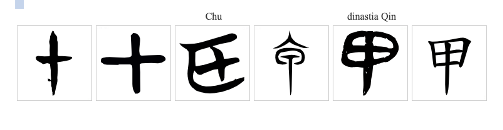
Mandarin dictionary
The first in the sky. Shell, shell, armor, a protective hard shell on an animal such as: turtle shell, scale armor. Protective clothing worn by ancient soldiers made of leather or sheet metal. It refers to soldiers. Same as "蛛" in ancient ancient times: shoulder blade.
Kangxi Dictionary
The first of the Ten Celestial Stems used to mark the year, month, and day.
The first generation of grass and trees. Thefirst group of things is called Jia. The storm is coming, and all the fruits, grass, and trees are covered in armor.
Yuanfeng of the Song Dynasty used the righteousness and courage of all people as protection. Shaoxing Xian ordered Huaihan Xian to take the two armors of the master's army. The ten soldiers were the armor and the five armors were the regiments.
"Fu Jia will attack him."
"The garment is also called Jia."
"Armor is like the shape of grass and trees growing from seeds."
Shouwen Dictionary
In the Historical Records and Almanacs it is said: Jia means that all things emerge from the armor of the talisman.
乙 YI The pictogram suggests the effort to germinate the seed. A plant in development. Original meaning: like a plant that twists and grows. Winding, rolling, sliding, twisting, Another older interpretation of the pictogram, from the first Chinese dictionary Erya 300ac. says: "The intestine of a fish"
Etymological evolution
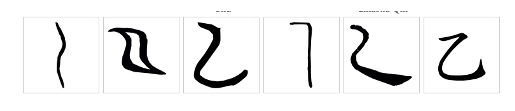
Mandarin dictionary
The second of the Ten Celestial Stems.
The order or degree belongs to the second. The second element to any item in an ordered list,
Compound words
Tai Yi, name of the star Nobleman Tai Yi.
Name of the Mountain, Tai Yi is close to the capital of the sky.
Tai Yi, immortal.
Kangxi Dictionary
A tree in spring that twists and its Yin Qi is still strong.
Jia means that all things come out of the armor; Ji means that all things are born and develop.
Historical documents from the text ——"Send to Weixuan" by Su Shi of the Song Dynasty. "There are bones on both sides of the tiger's ribs and at the end of the tail, which are shaped like the character 'Y'. The tiger is just as powerful as the word "Y," about three inches long. It is placed under the skin on both sides of the sidewall. If you wear it, it can intimidate the crowd when it approaches officials . No officer wears it, no one hates it. It's like a tiger holding the second hand. "
Shouwuen
Historical records say: Yi refers to the flow of all things.
丙 BING. Meanings of character radical traits (radicals are parts of a character that can provide an indication of its meaning) the first stroke 一 means one, the second stroke 入 means to enter inside, the third 冂 the outside.
There are several theories about the meaning of the pictogram: the shoulders (from the Shouwen dictionary). – the tail of a fish (from the Erya dictionary 300 BC).).– In addition: pedestal – coffee table – original shape of the handle.
Whatever its original meaning, it has been lost and replaced by its ancient use as the third of the ten Celestial Stems.
Baxter and Sagart (2014) note the phonological relationship between 丙 and 兩 "a pair"; the way these two are graphically related suggests that these two words are not only phonologically similar but also etymologically related, with 丙, meaning "couplet" or "bivalve", referring to an asterism.
Etymological evolution

Mandarin dictionary
Third place in Heaven. Used to arrange the order of the rankings, after A and B, indicating the third. Another name for fire. Synonymous with bright fire.
Compound words: Astronomy Huainanzi: "The day is Bingding" Bing and Ding are both fire."Sun of fire. Bing and Ding belong to fire in the five elements, so fire is commonly called " Bing " or " Bingding ". Fu bing 付丙 means to burn.
Kangxi Dictionary
Tai Sui in Bing is said to be a weak sign. The month is on Bing, which means repair. From Bing, the name of a deity.
Shouwen
"Located to the south, everything is perfect and bright. When Yin Qi begins to rise, Yang Qi decreases. From start to finish. One is Yang. Bing supports Yi, like a human sidekick."If the third is in the south, everything will become Bing." The south belongs to fire, and Bing and Ding are suitable for that, so Bing has the appearance of civilization.
丁 DING. Pictogram: The bronze inscription is shaped like a nail's head when viewed from above, and the small seal is shaped like a nail when viewed from the side. Original meaning: nail, Ding is the ancient word for "nail".
However, there are also several theories on the meaning of pictograms:
1- a city wall. The derivative 成 has the sense of becoming, realizing, completing and in other characters that contain Ding there is the meaning of standing upright, erect, correct position.
2- A head, the derivatives 天頂 have the sense of top of the sky, crown, the highest part of the head, others refer to original, Yuan energy. Yuan means origin, source. It is meant to indicate the cosmic energy that activates every phenomenon. It is the original Qi, the one we receive as an inheritance at birth, the result of the union of the mother's Jing with that of the father, combined with cosmic Qi.
Etymological evolution
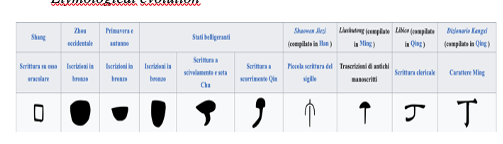
Mandarin dictionary
Ding, The fourth place of the Celestial Stems. Man. Adult men. Strong. A strong young man, a young male. People, population. A servant or person who performs certain jobs or occupations. For example: gardener, cook, housekeeper. Moving, meeting.
Examples of compound words: Dingdong, describes the sound of the beating of jade or wind chimes. Dinglin, simulates the sound of spring or dripping water. Dingcedīngcè, vecchio register of families
Kangxi Dictionary:
The fourth position of the celestial stems corresponds to the terrestrial branches and is used to record the year, month, and day.
A strong man.
Ji ding, the name of the scarab. People take it and take it with them. People like it and fall in love with it.
Shouwen
It is said that in summer everything is in full bloom. Ding Chengbing is like the human heart.
Everything is solid in summer.
戊 WU - The radicals, of the character, as well as the first pictograms show a spear with a large blade, a stick with a blade.
Etymological evolution
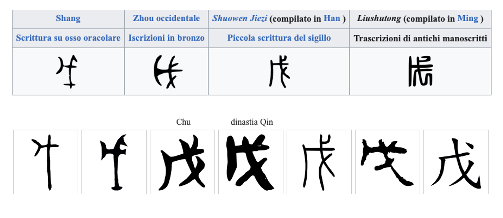
Mandarin dictionary
The fifth celestial stem. Orientation is central.
Kangxi Dictionary
It refers to the soil. For example: Wuji, referring to Wu and Ji over a ten-day period. Wuji belongs to the center and belongs to the earth in the five elements; thus, Wuji is used to refer to the earth; Wufang (Wuji Day). The sound is majestic. Between the ten stems. Everything is lush.
Shouwen
In ancient times, the ten stems were used to correspond to the five directions. Wu is among the ten stems, because it refers to the five or six in the center (?) that unite heaven and earth. The five dragons rule the five directions and are the gods of the five elements. The five dragons are the five elements.
The shape of the Wu character is said to be like the six armors and the five intertwined elements. It is as if Liujia and five dragons are held and intertwined together.
Connected to WU 戊 are:
兀 wù : tall and flat, also high and protruding.
屼 wù : themountain is bare and the mountain is steep. Towering: "There are stone peaks there."
阢 wù : the mountain is covered with earth.
剉 wù: the mountain is high and steep "The mountains are high and gloomy, the mountains rise up to the blue clouds".
己 Ji Pictogram: thread in a loom. The shape of the characters on the oracle bone is like the shape of a rope. "Ji" is the ancient word that is used to mean "himself" under the guise of "himself." Original meaning: silk thread, used to wrap silk bundles, oneself.
Etymological evolution
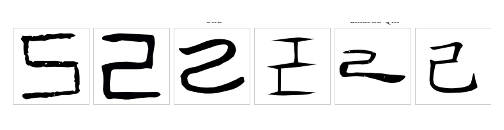
Mandarin dictionary
The sixth of the ten Celestial Stems.
Self, himself; personal, private, sacrificing oneself for the public good; being dissatisfied with oneself; know yourself.
Kangxi Dictionary
A gentleman appreciates others but despises himself , putting others before himself .
Shouwen
It is as if all things are hidden in different forms. Ji Cheng Wu is like a human belly."
"Wu and Ji are all in the palace. Therefore, the central soil is Wuji Day"
Lu Li Zhi said, "Discipline and self-discipline. The explanation of the name is: "Ji" – everything has a definite shape and can be recorded. When you're in the center and people are out, you can keep track of things."
Compound words, examples
Sī ji - money and goods stored privately by family members in the past.
Tī ji - close, caring - body language
庚 GENG Pictogram: Hands holding a shield. It contains the radical gong 廾 which means hands joined as a sign of respect, (more recently, bow,) and the radical gan 干 which means shield but also dry, devoid of moisture.
Etymological evolution

Mandarin dictionary
Age. Reimburse. Change.
Note by Zheng Xuan of the Han Dynasty: "Geng means compensation."
The seventh stem of the Ten Celestial Stems.
Kangxi Dictionary
Geng is in the west, it's like the Geng of everything in autumn.
Chang Geng, Mercury. The metal is located to the west of the sun, so when the sun is about to rise, it will be seen in the east.
Age is also called Geng.
Shouwen
Geng is to the west. The book of the law says so. Geng means that Yin Qi brings everything to change. Everything has solemnly changed. Geng shows the real new things. Like autumn, all things are full of reality.
Compound words: Chang Geng , one of the celestial phenomena, often classified as demonic energy or demonic star. It could refer to a comet of a specific shape, or it could be an aurora. "Historical documents. Volume 27. "Book of Heavenly Officers": "Chang Geng is like a piece of cloth that covers the sky. When you see this star, the army rises." Volume 1 and 2. "Astronomical Records": "Daemon Star: One is called a comet, the so-called sweeping star. ... Chang Geng is angry, bandits are rampant."
Gengxin, the main killer of ghosts and gods, in myths and legends. "Historical documents. Volume 27. "Book of Heavenly Officials"
辛 XIN Pictogram, from the oracle inscriptions on the bones it looks like an ancient torture knife. Original meaning: serious crime. Crime.
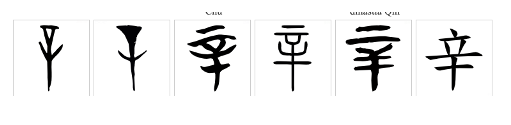
Mandarin dictionary
Pungent. Spicy taste.
Vegetables with a pungent flavor. Such as onions, garlic, etc.
"Compendium of Ming Dynasty Materia Medica "In the past, people abstained from five pungent foods to ward off evil spirits, which were called leeks, shallots, onions, garlic, and ginger.'"
Work, difficulty: hard work, toil.
Sadness: bitterness.
The eighth among the Celestial Stems.
Kangxi Dictionary
In autumn, all things are ripe. The taste of Xin is pungent and the pain makes you cry. It is said that all things are stopped for the first time, so it is painful. The reason gold tastes pungent is because Western evil is bad for things.
Shouwen
A serious sin. "Xin cries in pain, he is the image of a sinner. All the sins, the slaughter, the guilt, and the resignation all come from Xin."
Compound words: Xinchu suffering; Xinshang sadness.
Xinke spicy and severe; Xinliang spicy and fresh.
壬 REN Pictogram: Like a person carrying a weight. Original meaning: to carry a burden, a burden. The radicals that make up the character mean "pole for carrying work".
Etymological evolution
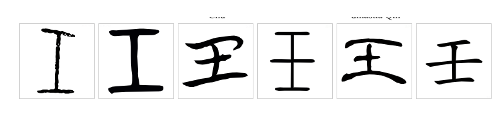
Mandarin dictionary
The ninth place of the celestial stems.
Traitor. An intelligent and flattering person. Skillful argumentation.
Ren-Gong is the legendary god of water. Therefore, it is the name of water.
Ren means great.
Kangxi Dictionary
The Ren location is to the north.
Shouwen
Ren is located to the north. The Yin and Yang poles arise, so "Yi" says: "Dragon fights in nature are connected."
"So Yi said. Dragons fight in the wild."
"Yin and Yang relationship, thingsare pregnant. Ren looks like a pregnant woman."
Compound words, examples: Renlin, great looks, Renren, a treacherous person.
癸 GUI Pictogram: the shape of the oracle characters on bone, represents two ancient crossed weapons . Original meaning: ancient weapons. Genre halberd.
Etymological evolution
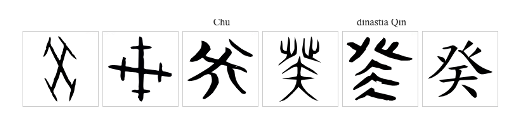
Mandarin dictionary
The tenth place of the celestial stems. Women's menstruation. Gui to the north rules the water.
Gui is the last of the celestial roots, and is homophonic with "ghost"; thus, the character Gui is used to refer to the Guimen Pass., ghost's gate.
Kangxi Dictionary
Gui means to return. It is winter at that time, the direction is north, the five elements belong to water and the five fortunes belong to fire.
Gui remembers the shape of water flowing into the earth from every direction. Gui Cheng Ren looks like a human foot.
Shouwen
In winter, the water and land are flat. You can enjoy it. The book of the law says so. Gui is also called Yan Kui. It is said that all things can be explored. Lu Li Zhi said "Gui. It is like water flowing over the earth from every direction."
Ten heavenly stems
Chinese Characters
甲 JIA – Pictogram. Germinating seed, and also armor. The image of a cracked seed coating worn by a plant after it has sprouted. Original meaning: the coating of seeds after they germinate, the outer shell of plant fruits: cracked (cracked appearance).
Etymological evolution
Mandarin dictionary
The first in the sky. Shell, shell, armor, a protective hard shell on an animal such as: turtle shell, scale armor. Protective clothing worn by ancient soldiers made of leather or sheet metal. It refers to soldiers. Same as "蛛" in ancient ancient times: shoulder blade.
Kangxi Dictionary
The first of the Ten Celestial Stems used to mark the year, month, and day.
The first generation of grass and trees. Thefirst group of things is called Jia. The storm is coming, and all the fruits, grass, and trees are covered in armor.
Yuanfeng of the Song Dynasty used the righteousness and courage of all people as protection. Shaoxing Xian ordered Huaihan Xian to take the two armors of the master's army. The ten soldiers were the armor and the five armors were the regiments.
"Fu Jia will attack him."
"The garment is also called Jia."
"Armor is like the shape of grass and trees growing from seeds."
Shouwen Dictionary
In the Historical Records and Almanacs it is said: Jia means that all things emerge from the armor of the talisman.
乙 YI The pictogram suggests the effort to germinate the seed. A plant in development. Original meaning: like a plant that twists and grows. Winding, rolling, sliding, twisting, Another older interpretation of the pictogram, from the first Chinese dictionary Erya 300ac. says: "The intestine of a fish"
Etymological evolution
Mandarin dictionary
The second of the Ten Celestial Stems.
The order or degree belongs to the second. The second element to any item in an ordered list,
Compound words
Tai Yi, name of the star Nobleman Tai Yi.
Name of the Mountain, Tai Yi is close to the capital of the sky.
Tai Yi, immortal.
Kangxi Dictionary
A tree in spring that twists and its Yin Qi is still strong.
Jia means that all things come out of the armor; Ji means that all things are born and develop.
Historical documents from the text ——"Send to Weixuan" by Su Shi of the Song Dynasty. "There are bones on both sides of the tiger's ribs and at the end of the tail, which are shaped like the character 'Y'. The tiger is just as powerful as the word "Y," about three inches long. It is placed under the skin on both sides of the sidewall. If you wear it, it can intimidate the crowd when it approaches officials . No officer wears it, no one hates it. It's like a tiger holding the second hand. "
Shouwuen
Historical records say: Yi refers to the flow of all things.
丙 BING. Meanings of character radical traits (radicals are parts of a character that can provide an indication of its meaning) the first stroke 一 means one, the second stroke 入 means to enter inside, the third 冂 the outside.
There are several theories about the meaning of the pictogram: the shoulders (from the Shouwen dictionary). – the tail of a fish (from the Erya dictionary 300 BC).).– In addition: pedestal – coffee table – original shape of the handle.
Whatever its original meaning, it has been lost and replaced by its ancient use as the third of the ten Celestial Stems.
Baxter and Sagart (2014) note the phonological relationship between 丙 and 兩 "a pair"; the way these two are graphically related suggests that these two words are not only phonologically similar but also etymologically related, with 丙, meaning "couplet" or "bivalve", referring to an asterism.
Etymological evolution
Mandarin dictionary
Third place in Heaven. Used to arrange the order of the rankings, after A and B, indicating the third. Another name for fire. Synonymous with bright fire.
Compound words: Astronomy Huainanzi: "The day is Bingding" Bing and Ding are both fire."Sun of fire. Bing and Ding belong to fire in the five elements, so fire is commonly called " Bing " or " Bingding ". Fu bing 付丙 means to burn.
Kangxi Dictionary
Tai Sui in Bing is said to be a weak sign. The month is on Bing, which means repair. From Bing, the name of a deity.
Shouwen
"Located to the south, everything is perfect and bright. When Yin Qi begins to rise, Yang Qi decreases. From start to finish. One is Yang. Bing supports Yi, like a human sidekick."If the third is in the south, everything will become Bing." The south belongs to fire, and Bing and Ding are suitable for that, so Bing has the appearance of civilization.
丁 DING. Pictogram: The bronze inscription is shaped like a nail's head when viewed from above, and the small seal is shaped like a nail when viewed from the side. Original meaning: nail, Ding is the ancient word for "nail".
However, there are also several theories on the meaning of pictograms:
1- a city wall. The derivative 成 has the sense of becoming, realizing, completing and in other characters that contain Ding there is the meaning of standing upright, erect, correct position.
2- A head, the derivatives 天頂 have the sense of top of the sky, crown, the highest part of the head, others refer to original, Yuan energy. Yuan means origin, source. It is meant to indicate the cosmic energy that activates every phenomenon. It is the original Qi, the one we receive as an inheritance at birth, the result of the union of the mother's Jing with that of the father, combined with cosmic Qi.
Etymological evolution
Mandarin dictionary
Ding, The fourth place of the Celestial Stems. Man. Adult men. Strong. A strong young man, a young male. People, population. A servant or person who performs certain jobs or occupations. For example: gardener, cook, housekeeper. Moving, meeting.
Examples of compound words: Dingdong, describes the sound of the beating of jade or wind chimes. Dinglin, simulates the sound of spring or dripping water. Dingcedīngcè, vecchio register of families
Kangxi Dictionary:
The fourth position of the celestial stems corresponds to the terrestrial branches and is used to record the year, month, and day.
A strong man.
Ji ding, the name of the scarab. People take it and take it with them. People like it and fall in love with it.
Shouwen
It is said that in summer everything is in full bloom. Ding Chengbing is like the human heart.
Everything is solid in summer.
戊 WU - The radicals, of the character, as well as the first pictograms show a spear with a large blade, a stick with a blade.
Etymological evolution
Mandarin dictionary
The fifth celestial stem. Orientation is central.
Kangxi Dictionary
It refers to the soil. For example: Wuji, referring to Wu and Ji over a ten-day period. Wuji belongs to the center and belongs to the earth in the five elements; thus, Wuji is used to refer to the earth; Wufang (Wuji Day). The sound is majestic. Between the ten stems. Everything is lush.
Shouwen
In ancient times, the ten stems were used to correspond to the five directions. Wu is among the ten stems, because it refers to the five or six in the center (?) that unite heaven and earth. The five dragons rule the five directions and are the gods of the five elements. The five dragons are the five elements.
The shape of the Wu character is said to be like the six armors and the five intertwined elements. It is as if Liujia and five dragons are held and intertwined together.
Connected to WU 戊 are:
兀 wù : tall and flat, also high and protruding.
屼 wù : themountain is bare and the mountain is steep. Towering: "There are stone peaks there."
阢 wù : the mountain is covered with earth.
剉 wù: the mountain is high and steep "The mountains are high and gloomy, the mountains rise up to the blue clouds".
己 Ji Pictogram: thread in a loom. The shape of the characters on the oracle bone is like the shape of a rope. "Ji" is the ancient word that is used to mean "himself" under the guise of "himself." Original meaning: silk thread, used to wrap silk bundles, oneself.
Etymological evolution
Mandarin dictionary
The sixth of the ten Celestial Stems.
Self, himself; personal, private, sacrificing oneself for the public good; being dissatisfied with oneself; know yourself.
Kangxi Dictionary
A gentleman appreciates others but despises himself , putting others before himself .
Shouwen
It is as if all things are hidden in different forms. Ji Cheng Wu is like a human belly."
"Wu and Ji are all in the palace. Therefore, the central soil is Wuji Day"
Lu Li Zhi said, "Discipline and self-discipline. The explanation of the name is: "Ji" – everything has a definite shape and can be recorded. When you're in the center and people are out, you can keep track of things."
Compound words, examples
Sī ji - money and goods stored privately by family members in the past.
Tī ji - close, caring - body language
庚 GENG Pictogram: Hands holding a shield. It contains the radical gong 廾 which means hands joined as a sign of respect, (more recently, bow,) and the radical gan 干 which means shield but also dry, devoid of moisture.
Etymological evolution
Mandarin dictionary
Age. Reimburse. Change.
Note by Zheng Xuan of the Han Dynasty: "Geng means compensation."
The seventh stem of the Ten Celestial Stems.
Kangxi Dictionary
Geng is in the west, it's like the Geng of everything in autumn.
Chang Geng, Mercury. The metal is located to the west of the sun, so when the sun is about to rise, it will be seen in the east.
Age is also called Geng.
Shouwen
Geng is to the west. The book of the law says so. Geng means that Yin Qi brings everything to change. Everything has solemnly changed. Geng shows the real new things. Like autumn, all things are full of reality.
Compound words: Chang Geng , one of the celestial phenomena, often classified as demonic energy or demonic star. It could refer to a comet of a specific shape, or it could be an aurora. "Historical documents. Volume 27. "Book of Heavenly Officers": "Chang Geng is like a piece of cloth that covers the sky. When you see this star, the army rises." Volume 1 and 2. "Astronomical Records": "Daemon Star: One is called a comet, the so-called sweeping star. ... Chang Geng is angry, bandits are rampant."
Gengxin, the main killer of ghosts and gods, in myths and legends. "Historical documents. Volume 27. "Book of Heavenly Officials"
辛 XIN Pictogram, from the oracle inscriptions on the bones it looks like an ancient torture knife. Original meaning: serious crime. Crime.
Mandarin dictionary
Pungent. Spicy taste.
Vegetables with a pungent flavor. Such as onions, garlic, etc.
"Compendium of Ming Dynasty Materia Medica "In the past, people abstained from five pungent foods to ward off evil spirits, which were called leeks, shallots, onions, garlic, and ginger.'"
Work, difficulty: hard work, toil.
Sadness: bitterness.
The eighth among the Celestial Stems.
Kangxi Dictionary
In autumn, all things are ripe. The taste of Xin is pungent and the pain makes you cry. It is said that all things are stopped for the first time, so it is painful. The reason gold tastes pungent is because Western evil is bad for things.
Shouwen
A serious sin. "Xin cries in pain, he is the image of a sinner. All the sins, the slaughter, the guilt, and the resignation all come from Xin."
Compound words: Xinchu suffering; Xinshang sadness.
Xinke spicy and severe; Xinliang spicy and fresh.
壬 REN Pictogram: Like a person carrying a weight. Original meaning: to carry a burden, a burden. The radicals that make up the character mean "pole for carrying work".
Etymological evolution
Mandarin dictionary
The ninth place of the celestial stems.
Traitor. An intelligent and flattering person. Skillful argumentation.
Ren-Gong is the legendary god of water. Therefore, it is the name of water.
Ren means great.
Kangxi Dictionary
The Ren location is to the north.
Shouwen
Ren is located to the north. The Yin and Yang poles arise, so "Yi" says: "Dragon fights in nature are connected."
"So Yi said. Dragons fight in the wild."
"Yin and Yang relationship, thingsare pregnant. Ren looks like a pregnant woman."
Compound words, examples: Renlin, great looks, Renren, a treacherous person.
癸 GUI Pictogram: the shape of the oracle characters on bone, represents two ancient crossed weapons . Original meaning: ancient weapons. Genre halberd.
Etymological evolution
Mandarin dictionary
The tenth place of the celestial stems. Women's menstruation. Gui to the north rules the water.
Gui is the last of the celestial roots, and is homophonic with "ghost"; thus, the character Gui is used to refer to the Guimen Pass., ghost's gate.
Kangxi Dictionary
Gui means to return. It is winter at that time, the direction is north, the five elements belong to water and the five fortunes belong to fire.
Gui remembers the shape of water flowing into the earth from every direction. Gui Cheng Ren looks like a human foot.
Shouwen
In winter, the water and land are flat. You can enjoy it. The book of the law says so. Gui is also called Yan Kui. It is said that all things can be explored. Lu Li Zhi said "Gui. It is like water flowing over the earth from every direction."
Pages: [1]